
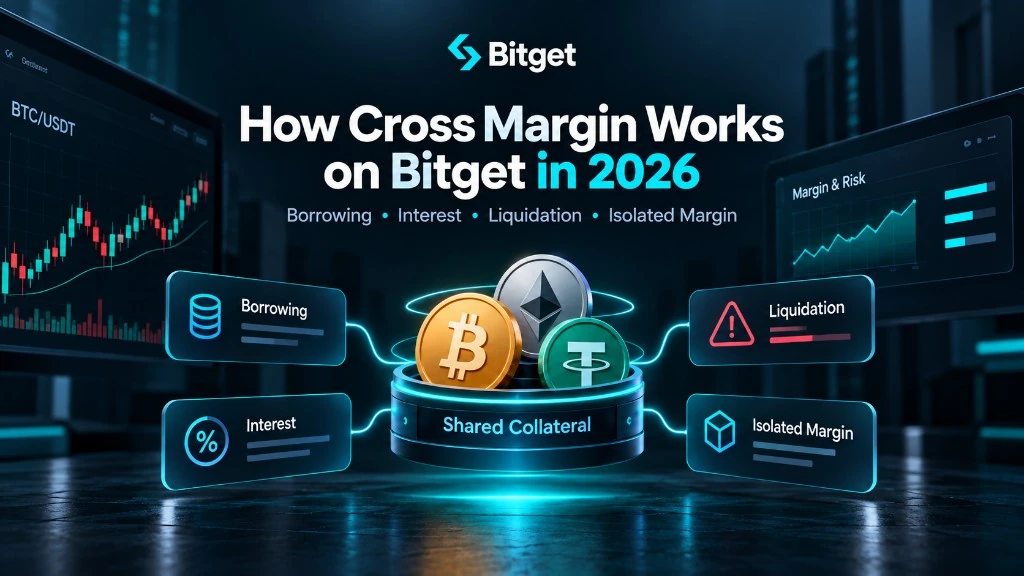
Cross Margin on Bitget 2026: Borrowing, Interest, Liquidation & Isolated Margin
Learn how Bitget cross margin works in 2026, including borrowing, interest, margin level, liquidation risk, collateral ratios, and cross margin vs isolated margin.
Learn how Bitget cross margin works in 2026, including borrowing, interest, margin level, liquidation risk, collateral ratios, and cross margin vs isolated margin.
Bitget Cross Margin Guide 2026: Borrowing, Interest & Liquidation Risk
Cross margin allows multiple supported positions to share eligible collateral instead of isolating margin to a single position or trading pair.
On Bitget, this matters especially under the Unified Trading Account, or UTA. Eligible assets can contribute to account collateral according to their collateral ratios. When a trade requires more of an asset than the account currently holds, borrowing may occur, creating both liabilities and interest costs.
Cross margin can improve capital efficiency, but it also makes risk more interconnected across the account.
> Quick Answer: Bitget cross margin is built around three connected elements: shared collateral, borrowing, and account-level risk management. Before using it, traders should look beyond the maximum leverage multiple and check borrowing rates, collateral ratios, margin level, maintenance-margin requirements, and liquidation risk.
---
What Does Cross Margin Mean?
The simplest cross margin meaning is:
> Multiple supported positions can use the same pool of eligible collateral.
Suppose an account holds:
- USDT
- BTC
- ETH
Under cross margin, eligible assets may contribute to the same broader collateral pool rather than being fully separated by position.
The main advantages are:
- less need to lock collateral to each individual position;
- unused eligible collateral can help support other positions;
- capital efficiency can be higher than in isolated structures.
But the downside is equally important:
- losses in one position can consume margin that supports other positions;
- falling collateral values can weaken the account at the same time;
- in extreme cases, more of the account can become exposed to liquidation risk.
So cross margin should not simply be understood as:
“more leverage.”
A better definition is:
shared collateral + account-level risk exposure.
If you are still choosing between spot, margin, and futures products, see our Bitget product guide.
---
How Does Bitget Cross Margin Work?
Under Bitget's Unified Trading Account, spot, margin, and futures activity can operate within a more integrated account framework.
A simplified process looks like this:
\`\`\`text
Deposit eligible assets
↓Apply collateral ratios
↓Calculate effective collateral value
↓Place leveraged trade
↓Borrow if available balance is insufficient
↓Borrowed amount becomes a liability
↓Interest + PnL + collateral value affect account risk
\`\`\`
One important point is:
Spot trading availability does not automatically mean margin borrowing is available.
Whether an asset can actually be borrowed may depend on:
- current borrowing support;
- user borrowing limits;
- available liquidity;
- leverage restrictions;
- collateral ratios;
- Bitget's current risk controls.
So the better question is not:
> “Does Bitget support margin trading?”
It is:
> “Does this asset, trading pair, and account mode support the borrowing required for this trade?”
---
How Do Bitget Margin Borrowing and Interest Work?
Margin trading creates leverage by allowing traders to use borrowed assets in addition to their own capital.
For example:
\`\`\`text
Available USDT: $5,000
Order value: $8,000
Funding gap: $3,000
\`\`\`
If the account is eligible, that $3,000 gap may become a borrowed amount.
The basic relationship is:
\`\`\`text
Amount to borrow
=
Trade amount
− Available balance
\`\`\`
Actual borrowing capacity can still be limited by:
- available account margin;
- borrowing limits;
- asset liquidity;
- leverage rules.
Borrowed assets can then generate interest.
A simplified estimate is:
\`\`\`text
Borrowing interest
=
Borrowed amount
× Borrowing rate
× Time
\`\`\`
For illustration only:
\`\`\`text
Borrowed amount: $10,000
Illustrative APR: 8%
Holding period: 3 days
\`\`\`
A rough annualized estimate would be:
\`\`\`text
$10,000 × 8% × 3 / 365
≈ $6.58
\`\`\`
This is only an example and does not represent a live Bitget borrowing rate.
Actual borrowing rates may change, so traders should check current platform data before opening a margin position.
A more complete margin cost estimate should include:
\`\`\`text
Trading fees
-
Borrowing interest
-
Spread / slippage
-
Potential liquidation costs
\`\`\`
rather than focusing only on the leverage multiple.
For a broader cost breakdown, see our Bitget fees guide.
---
Cross Margin vs Isolated Margin
The main difference in cross margin vs isolated margin is how far losses can spread.
| Feature | Cross Margin | Isolated Margin |
|---|---|---|
| Collateral | Shared across supported positions | Separated by position or pair |
| Capital efficiency | Generally higher | Generally lower |
| Risk isolation | Lower | Higher |
| Other assets may support a position | Yes, where eligible | Usually not |
| One loss can affect wider account | Yes | More limited |
| Better suited to | Account-level risk management | Position-level risk control |
Cross margin may give a position more room because other eligible collateral can support it.
But the same feature also means a losing position may affect more of the account.
Isolated margin makes it easier to define:
> How much collateral am I willing to expose to this position?
Neither mode is automatically safer in every situation.
---
What Is Margin Level and When Can Liquidation Happen?
Margin level or a similar account-risk metric helps show how much effective account value remains available to support leveraged liabilities.
Conceptually:
\`\`\`text
Higher effective equity
↓Larger margin buffer
More losses / liabilities
↓Smaller margin buffer
Maintenance threshold approached
↓Higher liquidation risk
\`\`\`
Several factors can weaken margin health:
- leveraged positions losing value;
- collateral assets losing value;
- additional borrowing;
- accumulated interest;
- lower collateral ratios;
- changes in maintenance-margin requirements.
This is especially important in cross margin.
For example, assume BTC is being used as collateral while the trader also holds another leveraged crypto position.
If the market falls broadly:
\`\`\`text
Trading loss
+Lower BTC collateral value
↓Smaller account safety buffer
\`\`\`
That is why cross-margin risk should be monitored at the account level rather than by looking only at one liquidation price.
---
Why Does Collateral Ratio Matter?
Not every asset necessarily contributes 100% of its market value as usable collateral.
For example:
\`\`\`text
Asset market value: $10,000
Collateral ratio: 80%
Effective collateral:
$10,000 × 80%
= $8,000
\`\`\`
If the collateral ratio later drops to 60%:
\`\`\`text
Effective collateral:
$10,000 × 60%
= $6,000
\`\`\`
The asset price did not change in this example.
But the usable collateral value fell by $2,000.
That can make the account more exposed even without a new trade.
So cross-margin users need to monitor both:
- the market value of collateral;
- the current collateral ratio applied to it.
Bitget may also change margin and loan support for specific assets as risk rules evolve. We previously covered one example in our Bitget margin and loan asset update.
---
What Changed for Bitget Margin Trading in 2026?
One of the most important developments in 2026 is the continued expansion of Bitget's Unified Trading Account.
Spot, margin, and futures activity are becoming more integrated under a common account and collateral framework.
This can make capital usage more efficient by:
- reducing repeated transfers between product wallets;
- improving collateral utilization;
- making assets and liabilities easier to manage in one account.
But the trade-off is that risk becomes more account-wide.
Cross-margin users may need to monitor:
\`\`\`text
Account balance
-
Collateral ratio
-
Borrowing eligibility
-
Outstanding debt
-
Interest
-
Position PnL
-
Maintenance margin
\`\`\`
rather than looking at a single isolated margin wallet.
---
What Should You Check Before Using Bitget Cross Margin?
Before placing a leveraged trade, check at least the following:
- Account Mode: confirm the active account and margin mode;
- Borrowing Support: verify that the required asset can actually be borrowed;
- Borrowing Limit: check the real amount available to borrow;
- Interest Rate: review the current borrowing rate;
- Collateral Ratio: understand how much of each asset counts as usable collateral;
- Margin Level / Risk Ratio: monitor the account's current risk position;
- Maintenance Margin: understand when risk controls may be triggered;
- Repayment: know how borrowed assets and accrued interest are repaid;
- Product Availability: confirm the asset still supports margin trading;
- Total Cost: include borrowing interest, not just trading fees.
A common mistake is treating:
maximum leverage
as the same thing as:
maximum safe position size.
They are not the same.
---
Final Takeaway
Bitget cross margin is not simply a feature that increases buying power.
It combines three important elements:
\`\`\`text
Shared collateral
-
Borrowing
-
Account-level liquidation risk
\`\`\`
Before using cross margin, traders should be able to answer five questions:
- What asset am I borrowing?
- What interest rate am I paying?
- Which assets are supporting the position as collateral?
- What collateral ratios apply?
- What happens if both the position and the collateral fall in value?
A better decision sequence is:
Collateral → Borrowing → Interest → Margin Level → Liquidation
Understand those variables first, then decide whether cross margin fits the trade.
---
Sources & Methodology
This guide is based primarily on Bitget's official documentation covering the Unified Trading Account, margin trading, borrowing, collateral ratios, and risk-management mechanics.
Because borrowing rates, collateral ratios, supported assets, leverage limits, and margin eligibility may change, traders should verify current platform parameters before placing a live trade.
> Disclaimer: BGBriefing is an independent research website and is not affiliated with Bitget. This article is for informational and educational purposes only and does not constitute investment or trading advice. Margin trading involves borrowing costs, amplified losses, and liquidation risk. Product availability, leverage limits, borrowing conditions, collateral ratios, and other rules may vary by asset, account type, and jurisdiction.
Frequently asked questions
What does cross margin mean?
Cross margin means multiple supported positions share eligible collateral instead of relying only on separately allocated margin. It can improve capital efficiency, but losses in one position may affect a larger part of the account.
How does cross margin work on Bitget?
Under Bitget's Unified Trading Account, eligible assets can contribute collateral according to their collateral ratios. If a margin trade requires more of an asset than the account currently holds, borrowing may occur if the account and asset are eligible.
What is the difference between cross margin and isolated margin?
Cross margin shares collateral across positions, while isolated margin separates collateral by position or trading pair. Cross margin generally offers greater capital efficiency, while isolated margin provides clearer position-level risk boundaries.
Does Bitget cross margin charge interest?
If the trade involves borrowed assets, borrowing interest may apply. Rates can change, so traders should check the current Bitget borrowing rate before opening a position.
What is margin level?
Margin level or a similar risk metric reflects how much effective account value is available relative to leveraged liabilities and margin requirements. As losses or liabilities increase, liquidation risk can rise.
Is cross margin safer than isolated margin?
Not necessarily. Cross margin can give a position access to more shared collateral, but it can also expose more of the account to losses. Isolated margin is generally easier to use when the goal is to limit the risk of a single position.

Report the page and describe what should be reviewed.