
Bitget to Disable Margin and Loan Functions for 9 Assets: What to Check Before September 11
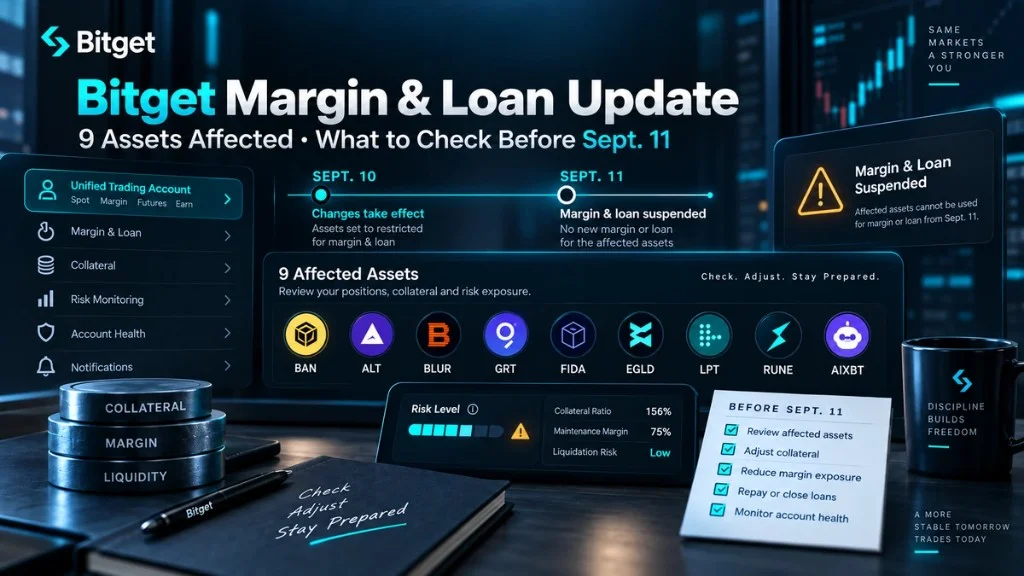
Bitget suspends margin and loan for BAN, ALT, BLUR, GRT, FIDA, EGLD, LPT, RUNE and AIXBT. Check loans, collateral and liquidation risk before Sept 11.
Published: September 10, 2026
Quick Answer
Bitget is changing margin and borrowing support for nine assets in its Unified Trading Account:
BAN, ALT, BLUR, GRT, FIDA, EGLD, LPT, RUNE and AIXBT.
According to Bitget’s official announcement, the schedule is:
| Time | Change |
|---|---|
| September 10, 2026, 18:00 (UTC+8) | Relevant loan services for the affected assets are suspended |
| September 11, 2026, 18:00 (UTC+8) | Related open margin orders are automatically canceled |
| September 11, 2026, 18:00 (UTC+8) | Relevant margin functions in Unified Trading Account are disabled |
| During the adjustment | Collateral / margin discount ratios for the affected assets are gradually reduced to 0 |
The main question is not simply whether these tokens will still appear on Bitget.
Users should check whether their accounts still contain:
- outstanding loans;
- margin positions;
- open leveraged orders;
- collateral exposure tied to these assets.
Bitget has warned that unresolved liabilities may result in system liquidation and potential losses.
---
Which 9 Assets Are Affected?
The adjustment covers:
BAN
ALT
BLUR
GRT
FIDA
EGLD
LPT
RUNE
AIXBT
It is important to distinguish:
An asset being affected by a margin-and-loan change does not automatically mean every Bitget product for that asset is being delisted.
This announcement focuses on:
margin and loan functions inside the Unified Trading Account.
So the announcement alone should not be used to conclude that:
- all spot trading will immediately stop;
- every futures contract will be delisted;
- withdrawals will stop;
- the asset is being fully removed from Bitget.
Each product category should be checked separately.
---
What Happens on September 10 at 18:00 (UTC+8)?
The first stage begins at:
September 10, 2026, 18:00 (UTC+8).
Bitget will suspend relevant loan services for the affected assets.
This means users should not interpret the final September 11 deadline as:
“I can continue borrowing these assets until then.”
New borrowing support is scheduled to stop earlier.
Users who use Unified Trading Account margin features should check:
- whether they have borrowed any of the affected assets;
- whether any liability remains unpaid;
- whether a strategy depends on additional borrowing;
- whether these assets are being used as collateral.
If the difference between Spot, Margin and Futures is still unclear, the Bitget product selection guide provides a useful way to separate the risk structure of each product.
---
What Happens on September 11 at 18:00 (UTC+8)?
The second key deadline is:
September 11, 2026, 18:00 (UTC+8).
Several changes are scheduled to take effect.
1. Open Margin Orders Will Be Canceled
Relevant unfilled margin orders will be automatically canceled.
For example:
Limit Margin Order
↓
Still unfilled
↓
Deadline arrives
↓
System cancels the order
If a trading strategy depends on those orders remaining active, their status should be checked before the deadline.
---
2. Relevant Margin Functions Will Be Disabled
The affected assets will no longer function in the same way inside the Unified Trading Account margin system.
This can change how users borrow, trade or use those assets as margin.
---
3. Outstanding Liabilities May Trigger System Liquidation
This is the most important risk.
Bitget has advised users to repay outstanding liabilities related to the affected assets before the deadline.
If those liabilities are not resolved:
System liquidation may occur.
That means users should review more than just total account balance.
The important fields include:
Borrowed Amount
+
Outstanding Liability
+
Margin Position
+
Collateral Status
---
Why Does a Collateral Discount Ratio of 0 Matter?
Inside a unified account, not every asset is always counted at 100% of market value for margin purposes.
Platforms often apply collateral or margin discounts based on the risk profile of each asset.
During this adjustment, Bitget plans to reduce the relevant collateral discount ratios to 0.
That means:
Even if the token remains in the account, its effective value as margin may decline or disappear.
A simplified example:
Account holds affected asset
↓
Asset previously contributes collateral value
↓
Discount ratio is reduced
↓
Effective margin value declines
↓
Overall account risk increases
If the same account also supports leveraged positions, this can result in:
- lower available margin;
- weaker maintenance-margin coverage;
- reduced distance to liquidation.
So the risk does not come only from the price of the affected token falling.
A change in collateral treatment can itself alter the risk profile of the entire unified account.
---
Does This Affect Users Who Have Not Borrowed These Assets?
Possibly, depending on how the assets are being used.
If a user only holds one of these assets in a simple spot balance and does not use it for:
- borrowing;
- margin trading;
- collateral;
- leveraged orders;
the direct effect of the margin-and-loan change may be more limited.
But if the asset contributes collateral value inside a Unified Trading Account, it can still matter even when the user has not opened a margin position in that same token.
That is one of the trade-offs of unified collateral systems.
Shared collateral improves capital efficiency, but it can also connect risks across different positions.
A rule change affecting one collateral asset can therefore change the margin available to support other positions.
---
What Is System Liquidation?
System liquidation can be simplified as:
The platform automatically manages or closes positions when the account no longer satisfies required margin conditions.
That is different from a user choosing to exit voluntarily.
A voluntary close looks like:
User identifies risk
↓
User reduces or closes position
System liquidation is closer to:
Margin becomes insufficient
↓
Risk threshold is reached
↓
Platform risk engine intervenes
↓
Position or collateral is processed
That is why users generally should not wait until the final minute to review an account once a collateral asset is scheduled to lose margin eligibility.
---
What Should Unified Account Users Check First?
A practical review can follow this order.
Step 1: Check Whether You Hold Any of the 9 Assets
BAN
ALT
BLUR
GRT
FIDA
EGLD
LPT
RUNE
AIXBT
A balance alone does not automatically create a problem, but it is the first filter.
Step 2: Check for Outstanding Loans
Review:
- borrowed amount;
- unpaid amount;
- accrued interest;
- repayment asset;
- final repayment deadline.
Step 3: Check Related Margin Positions
Do not look only at spot balances.
Check for:
- margin longs;
- margin shorts;
- leveraged open orders;
- auto-borrow-related orders.
Step 4: Check Whether the Assets Are Being Used as Collateral
If you use a Unified Trading Account, verify the current collateral status of the affected assets.
Step 5: Review Overall Account Risk
Pay attention to:
- Available Margin;
- Maintenance Margin;
- LTV;
- Liquidation Risk;
- Collateral Value.
---
What Should Institutional Loan Users Watch?
Bitget’s announcement also addresses institutional borrowing.
The affected trading pairs will stop being used as eligible collateral for certain institutional-loan functions.
That means an institutional account may experience:
Asset loses collateral eligibility
↓
Effective collateral declines
↓
LTV rises
↓
Liquidation risk increases
So reviewing the loan itself is not enough.
The more important calculation is:
After removing these assets from eligible collateral, does the account’s LTV remain within a safe range?
---
Is This the Same as a Spot Delisting?
Not exactly.
A margin-and-loan function change is about:
- whether the asset can be borrowed;
- whether it can be used as margin;
- whether related leveraged trading can continue.
Spot trading is a separate product category.
Bitget has also released other product-adjustment announcements around similar dates, and some assets may appear in more than one notice.
So the correct approach is not:
“BAN appears in this announcement, therefore every BAN function on Bitget disappears at the same time.”
Instead, check each product separately:
Spot
Margin
Unified Account
Futures
Bots
Copy Trading
Deposits
Withdrawals
Different products can have different timelines.
---
Does This Automatically Affect Perpetual Futures?
No conclusion should be drawn from the Unified Trading Account margin announcement alone.
Spot Margin and Futures are different products.
A perpetual contract depends on factors such as:
- whether the contract remains listed;
- margin requirements;
- leverage;
- mark price;
- funding;
- maintenance margin;
- whether Bitget has issued a separate futures notice.
If a user also holds perpetual positions, the relevant rules should be checked separately in the Bitget perpetual futures risk and order guide.
A Spot Margin announcement should not automatically be applied to Futures.
---
Do Users Need to Sell All 9 Assets Immediately?
This announcement does not by itself mean:
“Every user must sell all nine assets immediately.”
The relevant action depends on:
- whether the user has borrowed the asset;
- whether there is an open margin position;
- whether the asset is being used as collateral;
- whether there are unfilled margin orders;
- whether other product categories have separate changes.
The better sequence is:
Check the account state first, then decide whether any action is necessary.
---
Fees Should Be Checked Too
If a user needs to:
- repay loans;
- close positions;
- convert assets;
- replace collateral;
the adjustment can also create additional transaction costs.
These may include:
- trading fees;
- bid-ask spread;
- slippage;
- borrowing interest;
- conversion costs.
So a platform product change should be treated as an account-risk event rather than only a fee question.
The same principle in the Bitget total trading cost guide still applies:
Total cost is not just one maker or taker fee.
---
Checklist Before the Deadline
If your account involves any of the affected assets, check:
- [ ] Do I hold BAN, ALT, BLUR, GRT, FIDA, EGLD, LPT, RUNE or AIXBT?
- [ ] Do I have outstanding loans in any of these assets?
- [ ] Has unpaid borrowing interest accrued?
- [ ] Do I have any related Margin positions?
- [ ] Are there any unfilled margin orders?
- [ ] Are any of these assets being used as Unified Account collateral?
- [ ] Will my account risk increase when the collateral discount ratio falls?
- [ ] Do I need to add alternative collateral?
- [ ] Is there institutional-loan LTV risk?
- [ ] Are there separate Spot, Futures, Bot or Copy Trading announcements?
- [ ] Can all required actions be completed before the relevant deadline?
---
Timeline Recap
The adjustment can be reduced to two key times:
September 10, 2026
18:00 UTC+8
↓
Relevant loan services suspended

September 11, 2026
18:00 UTC+8
↓
Relevant open margin orders canceled
Relevant margin functions disabled
Unresolved liabilities may face system liquidation
The two deadlines should not be confused.
Loan-service suspension happens one day before the final margin-function shutdown.
---
Final Takeaway
The most important issue in this update is not the names of the nine tokens.
It is that their role inside the Unified Trading Account is changing.
If an asset is simply held in a spot balance, the impact may be relatively limited.
If it is being used as:
- a borrowed asset;
- a leveraged position;
- collateral;
- institutional-loan collateral;
then the change in margin eligibility and discount treatment can affect the entire account’s risk profile.
Before the deadline, the four most useful questions are:
What do I owe?
What am I using as collateral?
What happens to my risk ratio when the collateral value falls?
Which open orders or positions depend on this asset?
Answer those first, then decide whether repayment, position reduction, collateral replacement or another action is needed.
---
Sources & Methodology
This article is based on Bitget’s September 2026 announcement covering margin and loan changes for selected assets in the Unified Trading Account.
The asset list, timing, treatment of open orders, unresolved liabilities and collateral-discount adjustments should ultimately be verified against Bitget’s latest official notice and the user’s current account interface.
Disclaimer: BGBriefing is an independent research website and is not affiliated with Bitget. This article is intended to explain a platform-product adjustment and related risk mechanics. It does not constitute investment, trading or asset-disposal advice. Margin and borrowing products can involve forced liquidation, borrowing costs, slippage and rapid losses. Users with exposure to the affected assets should verify their current Bitget account status and the latest official announcement.
Frequently asked questions
Which 9 assets are affected by Bitget’s margin and loan adjustment?
The affected assets are BAN, ALT, BLUR, GRT, FIDA, EGLD, LPT, RUNE and AIXBT.
When will borrowing services stop?
According to Bitget’s announcement, the relevant loan services are scheduled to stop on September 10, 2026, at 18:00 (UTC+8).
When will margin functions be disabled?
The related Unified Trading Account margin functions are scheduled to be disabled on September 11, 2026, at 18:00 (UTC+8).
What happens to existing loans?
Bitget recommends repaying outstanding liabilities before the September 11 deadline. Unresolved liabilities may be subject to system liquidation.
What happens to unfilled margin orders?
Relevant unfilled margin orders are scheduled to be automatically canceled on September 11, 2026, at 18:00 (UTC+8).
What does a collateral discount ratio of 0 mean?
It means the affected asset will no longer contribute the same effective collateral value inside the Unified Trading Account. That can increase account-level margin risk.
Will normal spot balances be automatically liquidated?
This margin-and-loan announcement alone does not support that conclusion. The notice focuses on Unified Trading Account margin, borrowing and collateral treatment. Spot product status should be checked separately.
Will perpetual futures also be disabled?
Not automatically. Futures are a separate product category and should be checked against any dedicated futures notice.
Why can the same asset appear in multiple Bitget adjustment notices?
Bitget may separately adjust Spot, Margin, Bots, Copy Trading, Unified Account or other products. The same asset can therefore appear in several announcements with different deadlines. ---

Report the page and describe what should be reviewed.