
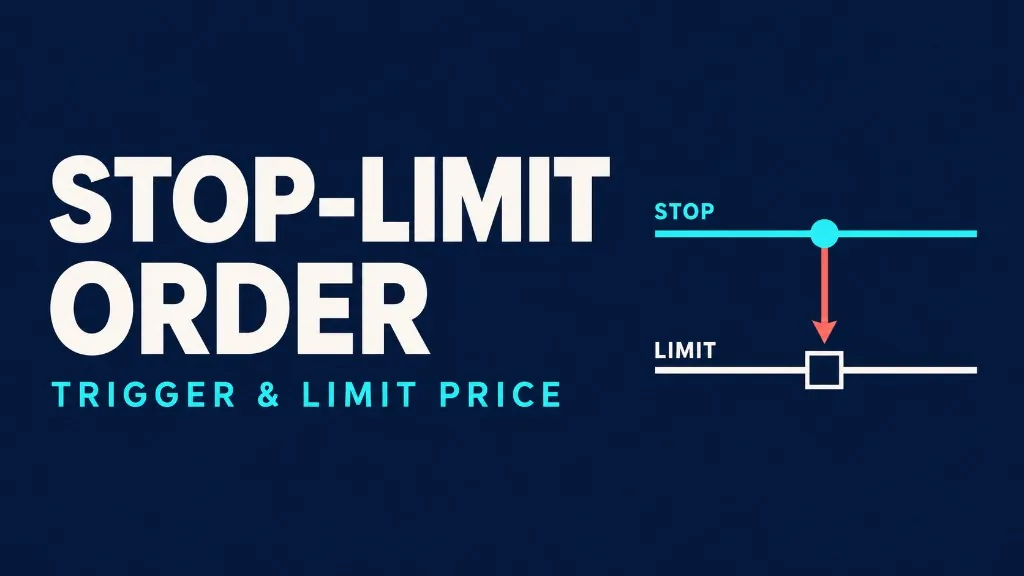
Stop Limit Order: How It Works and Why It May Not Fill
Learn how stop-limit orders work, how stop and limit prices differ, and why fast-moving markets can leave an order unfilled.
Learn how stop-limit orders work, how stop and limit prices differ, and why fast-moving markets can leave an order unfilled.
Quick Answer
A stop-limit order combines two prices: a stop price that activates the order and a limit price that controls the worst price you are willing to accept. Once the stop is reached, the order becomes a limit order. This can improve price control, but execution is not guaranteed if the market moves past the limit too quickly.
Key Takeaways
- The stop price activates the order; the limit price sets the acceptable execution boundary.
- A stop-limit order is not the same as a guaranteed exit.
- Fast markets can trigger the order and still leave it unfilled.
- Buy and sell stop-limit orders require different price logic.
- Use small test orders before relying on any new order type in a volatile market.
Key Table
| Component | What it does | Main risk |
|---|---|---|
| Stop price | Activates the order after a market price condition is met | Activation can occur during a sharp move |
| Limit price | Sets the least favorable price you accept | Market may move beyond it, leaving no fill |
| Sell stop-limit | Can seek to sell after downside confirmation | Price may fall below the limit too quickly |
| Buy stop-limit | Can seek to buy after upside confirmation | Price may rise above the limit before execution |
How a Stop-Limit Order Works
A stop-limit order has two stages. Before the stop price is reached, it is inactive. Once the market reaches the activation condition, it becomes a regular limit order.
For a sell stop-limit order, a trader may set a stop price below the current market price and a limit price at or below that stop. The goal is often to exit if price weakens, while still avoiding execution far below an acceptable level.
For a buy stop-limit order, a trader may use a stop above the current price to enter after a breakout. The limit price then caps the purchase price the trader is prepared to pay.
Exact order behavior, permitted price ranges, and trigger references can vary by venue. Always review the order ticket and product rules before placing a live order.
Why a Trigger Does Not Guarantee a Fill
The most important stop-limit rule is simple: activation is not execution.
Imagine an asset trading at 100. A trader enters a sell stop-limit order with a stop at 95 and a limit at 94. If the market moves gradually from 100 to 95, the limit order may find buyers near 94 or better. But if the price gaps from 95 to 91 during a fast sell-off, the sell limit at 94 may remain open without filling.
This is not necessarily a system failure. It is the trade-off for price control. The trader has said, in effect, “sell only at 94 or above.” If buyers are only available below 94, the order cannot execute under those terms.
That is why an exit plan should include more than an order type. Consider liquidity, normal volatility, position size, and what you will do if a stop-limit order remains open while the market keeps moving.
Stop Loss vs Stop Limit
A stop-loss order and a stop-limit order serve different priorities.
A stop-loss style order generally prioritizes getting out once a trigger condition is reached, though the final execution price can be worse than expected in a fast market. A stop-limit order prioritizes price discipline by refusing to execute beyond the stated limit, but that can mean remaining in the position.
Neither is universally better. If avoiding further exposure is the top priority, execution certainty may matter more. If avoiding an unacceptable execution price is the priority, a stop-limit structure may be more appropriate. The correct choice depends on the trader’s risk plan rather than the label of the order.
Before using conditional orders alongside leveraged positions, understand how margin and liquidation can affect the outcome. This cross-margin guide explains why account-level collateral rules matter.
Where Trailing Stops Fit
A trailing stop order uses a changing trigger level that follows price movement according to a defined distance or percentage. It can help traders protect gains without manually moving a stop after every favorable move.
However, a trailing stop is not automatically better than a stop-limit order. It may trigger during ordinary volatility, and its execution mechanics still depend on the order type and market conditions. A trader should decide first whether the goal is price control, exit speed, or protecting a portion of unrealized gains.
A Safer Setup Checklist
- Confirm whether the order is a stop, stop-limit, or trailing order.
- Check which reference price triggers it.
- Write down both the trigger price and the limit price.
- Estimate whether the gap between them is realistic for current volatility.
- Use a smaller order first if you are unfamiliar with the interface.
- Do not assume an unfilled stop-limit order has removed market risk.
- Review all open conditional orders after major price moves.
Risk Disclaimer
Conditional orders do not eliminate market risk. In volatile conditions, orders may trigger, fill at different prices than expected, or remain unfilled. This article is for general education only and is not investment advice.
Frequently asked questions
Does a stop-limit order guarantee my selling price?
No. It sets the lowest acceptable price for a sell order, but if buyers are unavailable at that price, the order may not fill.
What is the difference between stop price and limit price?
The stop price activates the order. The limit price determines the worst price you accept for execution.
Can a stop-limit order be used with leveraged trading?
It can be used as part of a risk plan, but it does not override margin, liquidation, or platform risk rules.

Report the page and describe what should be reviewed.