
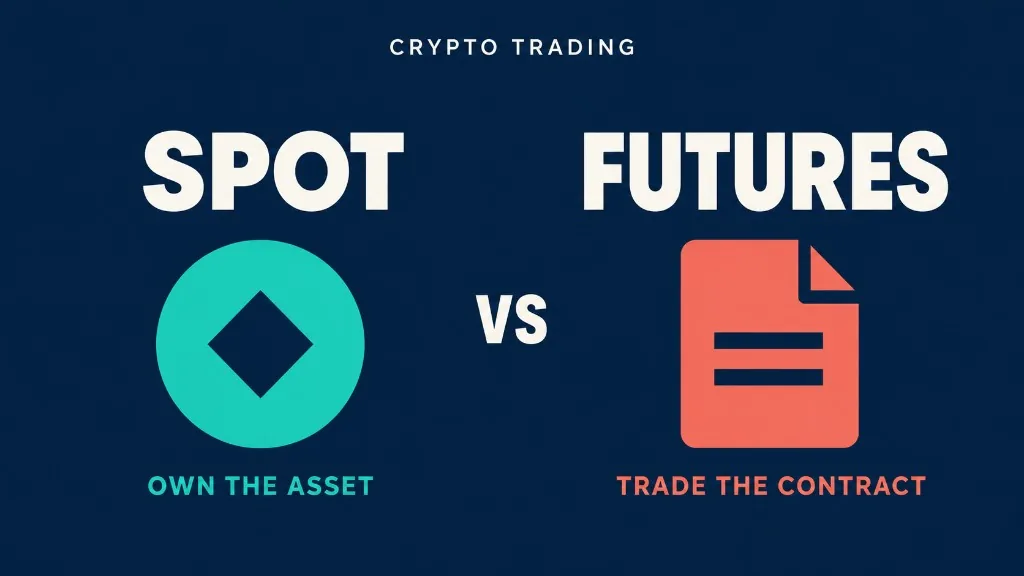
Spot vs Futures: Which Trading Approach Fits Your Risk Plan?
Understand the practical differences between spot and futures trading, including ownership, leverage, liquidation, costs and risk management.
Understand the practical differences between spot and futures trading, including ownership, leverage, liquidation, costs and risk management.
Quick Answer
Spot trading generally involves buying or selling an asset at the current market price, while futures trading uses contracts that track an asset’s price. Spot positions do not normally face liquidation from leverage, but the asset price can still fall. Futures can provide long or short exposure and capital efficiency, but leverage, funding, and margin rules create a higher risk of rapid losses.
Key Takeaways
- Spot trading is usually simpler because you trade the asset itself rather than a leveraged contract.
- Futures can be used for directional exposure or hedging, but they require active margin management.
- A spot buyer can lose value if the asset falls; a futures trader can lose collateral faster because of leverage.
- Funding, fees, and liquidation rules matter more in futures than in ordinary spot transactions.
- The right choice depends on your time horizon, downside tolerance, and ability to monitor risk.
Key Table
| Feature | Spot trading | Futures trading |
|---|---|---|
| What you trade | The asset itself | A derivative contract linked to price |
| Leverage | Often not required | Commonly available |
| Short exposure | Usually requires separate borrowing arrangements | Generally possible through a short contract |
| Liquidation risk | No standard leveraged liquidation for an unleveraged purchase | Possible when margin falls below requirements |
| Main focus | Entry price, custody and exit plan | Margin, leverage, funding, liquidation and exit plan |
Ownership and Exposure Are Different Decisions
In spot trading, purchasing an asset normally means your account balance reflects ownership of that asset. If its price declines, the value of the balance declines, but an unleveraged spot purchase is not typically force-closed merely because price falls.
Futures trading is different. You hold a contract whose profit or loss follows price movement. That structure can help a trader express a bearish view, hedge existing exposure, or use less collateral for a given notional position. It also means that risk must be monitored more closely.
The distinction matters when markets become volatile. A spot holder may decide to wait, sell gradually, or transfer assets subject to applicable platform rules. A futures trader may have far less time to act if the liquidation threshold is close.
Before choosing either route, start with the purpose of the trade. Are you seeking exposure to an asset over time? Are you trying to hedge a position? Or are you attempting a short-term trade that you can monitor continuously? One product is not universally better; the trade objective should drive the product choice.
Why Futures Require a More Detailed Risk Plan
Futures allow a position larger than the collateral posted. This can make capital use look efficient, but the same mechanism magnifies losses. A small unfavorable move can have a large effect on margin when leverage is high.
A disciplined futures plan should include:
- entry price and invalidation level;
- maximum amount of collateral at risk;
- leverage level and estimated liquidation distance;
- expected holding period;
- possible funding payments;
- an exit plan if volatility increases.
It is also important to understand the difference between isolated and cross-margin arrangements. With isolated margin, risk is generally limited to the collateral allocated to that position, subject to the product’s rules. With cross margin, available account collateral may support multiple positions, which can improve flexibility but can also spread risk across the account. Review the cross-margin guide before assuming that one losing position cannot affect another.
Spot Trading Has Risks Too
Calling spot trading “safer” can be misleading if it encourages careless sizing. Spot buyers can still experience substantial drawdowns, especially in highly volatile assets. Concentrating too much capital in one asset, buying without a time horizon, or keeping long-term holdings without a security plan are all meaningful risks.
The main advantage of unleveraged spot trading is structural: a price decline alone does not normally create a leveraged liquidation event. That can give a trader more room to follow a longer-term plan. It does not guarantee recovery or protect against permanent loss of value.
Security also matters. If your spot holdings are intended for longer-term use, account protection, withdrawal verification, and phishing awareness deserve as much attention as entry timing. Use this account-security checklist as a starting point.
A Practical Way to Decide
Spot trading may be more suitable when you:
- want direct asset exposure;
- do not want to manage liquidation thresholds;
- have a longer holding horizon;
- prefer a simpler position structure.
Futures may be more suitable when you:
- understand leverage and margin mechanics;
- need to hedge an existing exposure;
- have a defined short-term trading plan;
- can monitor positions and react to changing conditions.
It is reasonable to use neither product when the trade thesis is unclear. Waiting for a setup you can explain is often better than using leverage to compensate for uncertainty.
Risk Disclaimer
Crypto assets and derivatives are volatile. Futures trading can result in rapid losses, especially when leverage is used. This content is educational and does not constitute investment, legal, or tax advice.
Frequently asked questions
Is spot trading better than futures for beginners?
Spot trading is often easier to understand because it does not require continuous margin and liquidation management. However, every trade still carries market risk.
Can futures be used to hedge a spot position?
A futures short position can potentially offset some downside in a spot holding, but hedging introduces contract, funding, sizing, and liquidation considerations. It should be planned carefully.
Does spot trading have no fees?
Spot trading may involve trading fees, spreads, withdrawal fees, and network fees. Check the full cost structure rather than assuming spot is cost-free.

Report the page and describe what should be reviewed.