
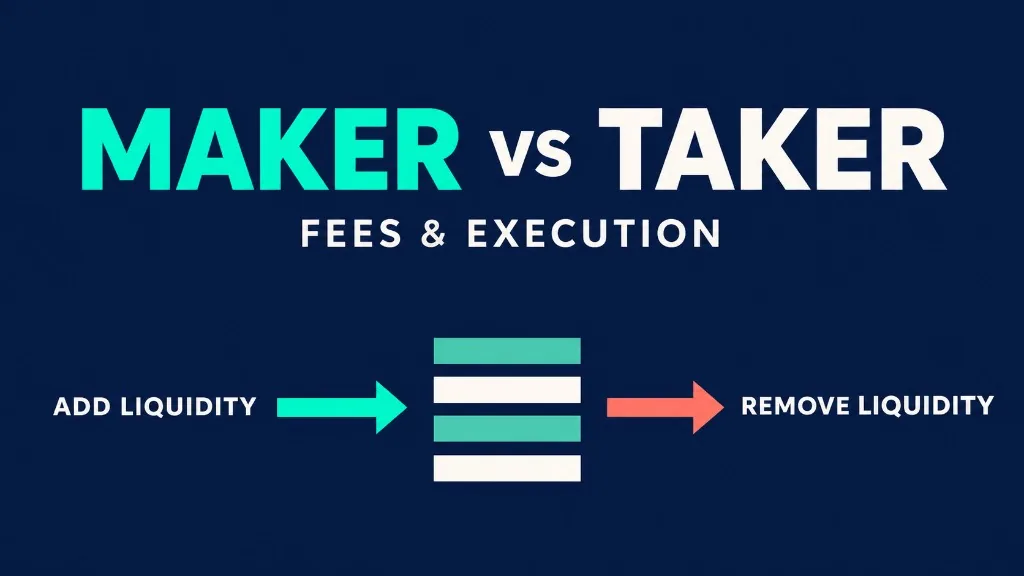
Maker vs Taker: How Trading Fees and Execution Differ
Learn the difference between maker and taker orders, how each affects liquidity and fees, and why a limit order is not always a maker order.
Learn the difference between maker and taker orders, how each affects liquidity and fees, and why a limit order is not always a maker order.
Quick Answer
A maker order adds liquidity by resting on an order book until another trader matches it. A taker order removes existing liquidity by executing against orders already available. Fees often differ between makers and takers, but the classification depends on how the order executes—not simply on whether you clicked “limit” or “market.”
Key Takeaways
- Makers add resting orders to the order book.
- Takers execute against available orders immediately or almost immediately.
- A market order is usually a taker order.
- A limit order can be either maker or taker depending on its price and execution.
- Lower fees do not automatically mean better execution or lower total trading cost.
Key Table
| Order outcome | Maker | Taker |
|---|---|---|
| Liquidity effect | Adds liquidity | Removes liquidity |
| Typical order behavior | Rests until matched | Executes against existing quotes |
| Common fee treatment | May receive a different fee rate | May receive a different fee rate |
| Main consideration | Fill uncertainty | Price impact and execution cost |
What Makes an Order a Maker Order
A maker order does not immediately trade against another order. Instead, it sits on the order book at a chosen price and waits for a buyer or seller to accept it.
For example, if the best available sell price is 100 and you place a buy limit order at 98, the order may rest in the book. It is providing liquidity at that price, so it is typically treated as a maker order if it later fills.
The benefit is potential fee efficiency and price control. The trade-off is uncertainty: the market may never reach your chosen price, or it may move away before the order fills.
What Makes an Order a Taker Order
A taker order accepts liquidity that already exists in the market. A market order is commonly a taker because it seeks immediate execution against the best available quotes.
However, a limit order can also become a taker order. If the best sell price is 100 and you submit a buy limit order at 101, the order may execute immediately at available sell prices. Even though you selected a limit order, you removed liquidity rather than adding it.
This is why order labels should not replace understanding. The key question is whether the order will rest or cross the current order book.
Fees Are Only One Part of Execution Cost
Maker-taker fee schedules can be useful, especially for frequent traders. But the lowest listed fee does not always produce the lowest total cost.
A maker order may have a favorable fee rate but fail to fill while the market moves away. A taker order may fill quickly but face spread and slippage, particularly when liquidity is thin or the order size is large.
When estimating the real cost of a trade, consider:
- maker or taker fee rate;
- bid-ask spread;
- expected slippage;
- chance of partial fills;
- urgency of execution;
- the risk of missing the trade entirely.
For a broader explanation of trading and account costs, see how platform fees work.
Choosing Between Maker and Taker Execution
Maker orders may be more appropriate when price discipline matters more than immediate execution. They can suit traders who have a target entry or exit level and are willing to wait.
Taker orders may be more appropriate when execution speed is more important, such as when reducing risk in a fast-moving market. But speed should not be confused with certainty of a favorable price.
Before placing a large order, inspect the visible order book and consider splitting the order if liquidity appears limited. If you are using leverage, remember that delayed or partial fills can affect margin exposure. This cross-margin guide explains why account-level risk can matter beyond a single order.
Risk Disclaimer
Trading costs and order execution can vary with market conditions, liquidity, product rules, and account tier. This article is for general education only and is not investment advice.
Frequently asked questions
Is every limit order a maker order?
No. A limit order that executes immediately against existing orders is generally treated as a taker order.
Is every market order a taker order?
Market orders usually take available liquidity, so they are commonly taker orders. Exact treatment depends on venue rules.
Should I always choose maker orders for lower fees?
Not necessarily. A lower fee may not offset the risk of not being filled or missing a necessary exit.

Report the page and describe what should be reviewed.