
Bitget clarifies it is not MAS-regulated in Singapore, and publishes its global compliance map
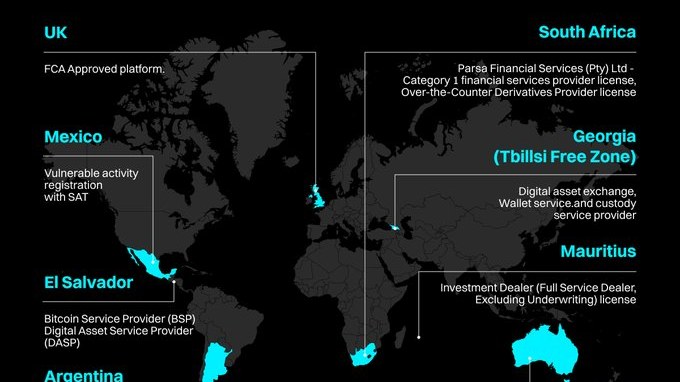
On 22 July, Bitget issued a public statement confirming that it is not licensed, approved, registered, authorized or regulated by the Monetary Authority of Singapore (MAS). In the same update, the platform also published a global compliance map outlining disclosures across markets including the UK, Australia and South Africa.
The point of this update is not another new licence. Bitget first draws a clear line in Singapore—no MAS relationship—and then uses a global compliance map to show what it has publicly disclosed elsewhere.
TL;DR
- Bitget states clearly that it has no MAS licence, approval, registration, authorization or regulatory relationship in Singapore.
- The same update includes a Bitget Compliance Map covering multiple jurisdictions.
- What matters is not whether the platform operates globally, but whether your market and product match what is disclosed.
- Regulatory status changes; verify against official sources rather than relying on a map alone.
Start with the boundary
On 22 July, Bitget’s official X account posted a blunt statement. The English text reads: “As part of our commitment to regulatory transparency, Bitget clarifies that it is not licensed, approved, registered, authorized or regulated by the Monetary Authority of Singapore (MAS).”
The Chinese version makes the same point: Bitget has not obtained any licence, approval, registration, authorization or regulatory relationship from MAS. If you have been trying to work out Bitget’s regulatory status in Singapore, this official statement is about as direct as it gets.
The same post includes a “Bitget Compliance Map.” On one side: where Bitget says it is not regulated. On the other: where it says it has made disclosures. Two messages, one update.
Draw the Singapore line first
In crypto platform communications, the usual story is “we got another licence.” Bitget went the other way: it started with where it is not regulated.
That is uncommon, and useful. Many users rely on a shortcut: “big platform = works everywhere = locally regulated.” Those three steps do not always line up.
This update at least removes the first guesswork: do not assume a MAS relationship in Singapore.
One map, eight markets
According to the official graphic, Bitget highlighted disclosures including the UK (FCA Approved platform), Australia (Digital Currency Exchange provider registration), South Africa (Category 1 financial services provider license and OTC Derivatives Provider license), El Salvador (BSP / DASP), Argentina (virtual asset service provider), Mexico (Vulnerable activity registration with SAT), Georgia’s Tbilisi Free Zone (exchange, wallet and custody services), and Mauritius (Investment Dealer license).
The easy mistake is to read this as: one registration in one country equals full regulatory coverage for everything you use there. An FCA reference, an Australian DCE registration, a South African financial services licence and an OTC derivatives permission are not the same thing.
The map is informative; it is not a single global licence.
In Singapore and elsewhere, you are not looking at the same picture
If you are in Singapore, or mainly use Singapore-related entry points, treat the statement as a hard boundary: do not assume MAS oversight. Account access, deposits, product permissions and risk disclosures should be checked against what your account and applicable terms actually show.
If you are in other countries or regions, the compliance map is a clue, not a pass. You still need to verify the service entity behind your account, whether the product you want is available to you, and whether official notices have changed.
For platform researchers, the value is in the combination: Bitget did not only say “we are compliant,” and it did not dodge “where we are not regulated.” It did both.
Three checks beat staring at a map
First, go back to the official source—reposts often drop licence types and dates. Second, separate registration, licence and authorization; exchange, wallet/custody, investment dealer and OTC derivatives are different labels.
Third, check your scenario, not the platform’s global story. A disclosure in one country does not automatically apply to your account path, funding route or product access.
Regulatory status changes. Set a review date rather than filing this away as permanent fact.
Do not let “global compliance” do all the thinking
In one line: Bitget drew a boundary in Singapore and put its global compliance layout on the table at the same time.
For everyday users, the useful question is not “is this platform compliant in general,” but: in the market you care about, what has Bitget disclosed, what has it not, and where do you verify that?

Report the page and describe what should be reviewed.