
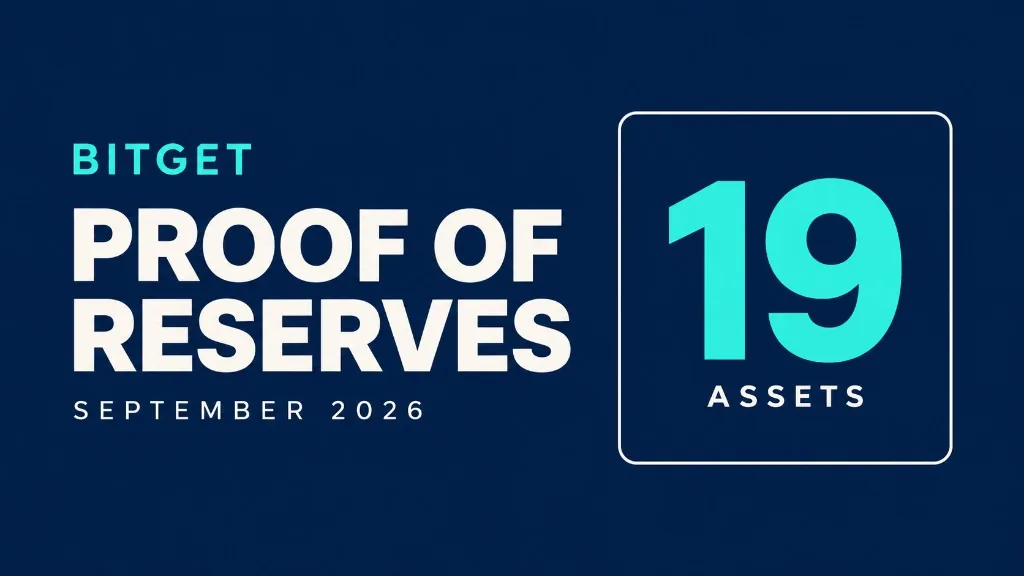
Bitget’s September Proof-of-Reserves Update Covers 19 Assets: What It Verifies—and What It Doesn’t
Bitget’s September proof-of-reserves update reported a 131% overall reserve ratio across 19 covered assets. Understand what a reserve report can and cannot establish.
Bitget’s September proof-of-reserves update reported a 131% overall reserve ratio across 19 covered assets. Understand what a reserve report can and cannot establish.
Quick Answer
Bitget’s September proof-of-reserves update reported a 131% overall reserve ratio for 19 covered assets, based on a September 29 snapshot. That can help users assess whether disclosed reserves exceeded the stated covered balances at that point in time.
It does not, by itself, prove that every asset is covered, every liability is visible, withdrawals will always be available, or every operational and cybersecurity risk has disappeared. Treat it as one custody-transparency input alongside account protection, product terms and your own exposure limits. The Bitget account-security checklist covers the controls users can apply directly.
Key Takeaways
- The reported 131% figure is a snapshot, not a perpetual guarantee.
- The update describes coverage across 19 assets; read the covered-asset list before treating it as account-wide protection.
- A proof-of-reserves audit can support transparency, but its scope depends on the method, timing and disclosed liabilities.
- Reserve coverage is different from password security, phishing protection, product liquidity and regional availability.
- Users should keep independent account controls active even when a platform publishes reserve data.
Key Table
| Question | What the update can help answer | What still needs separate checking |
|---|---|---|
| Were covered reserves above stated covered balances? | The reported snapshot indicates that relationship for its stated scope | Methodology, asset list and snapshot date |
| Are all platform risks removed? | No | Security, operations, liquidity, legal and product risks |
| Does the figure guarantee a withdrawal? | No | Account status, asset, network, product and regional conditions |
| Can the user improve account security? | Yes, independently | Passkeys, 2FA, anti-phishing controls and withdrawal protection |
What a 131% reserve ratio means
A reserve ratio compares disclosed reserves with the liabilities or user balances included in the report’s stated scope. A ratio above 100% indicates that the reported reserves exceeded the reported covered balance at the snapshot time. It does not mean that a user should ignore the report’s methodology, eligible assets or date.
For this update, the useful questions are: which 19 assets were covered, how were balances measured, when was the snapshot taken, and what can an individual account verify? Those details are more informative than treating one headline percentage as a universal safety score.
What proof of reserves does not settle
Proof of reserves is not the same as a complete financial audit. It does not automatically evaluate all business liabilities, future losses, governance, operational continuity, market liquidity or legal claims. It also cannot protect an account whose email, device or API key has been compromised.
That distinction matters because exchange security has layers. Reserve transparency addresses one custody question. A unique password, passkey or authenticator, anti-phishing code, device review and withdrawal controls address different risks. Use the account-security checklist for the actions that remain under your control.
A practical way to use the update
Use reserve data as a prompt to reduce assumptions, not to add them. Confirm whether the assets you hold are within the reported scope. Review current withdrawal and product conditions. Avoid leaving API keys or old sessions active. If you hold assets across venues, track where the custody and withdrawal risks sit rather than relying on one platform-level ratio.
Risk Disclaimer
Reserve reports have defined methods and scope. Crypto assets can lose value, and exchange, custody, product and account-security risks remain. This article is for information only and is not investment, legal or tax advice.
Frequently asked questions
What is proof of reserves?
It is a transparency process intended to compare disclosed platform-held assets with the covered user balances or liabilities defined by the report.
Does a reserve ratio above 100% eliminate exchange risk?
No. It is evidence about the report’s stated reserve relationship at a point in time. It does not eliminate operational, cybersecurity, liquidity, legal, product or user-account risks.
What should I check besides reserve data?
Check the asset scope, snapshot date and methodology, then review account security, withdrawal protections, product terms and regional eligibility.

Report the page and describe what should be reviewed.