
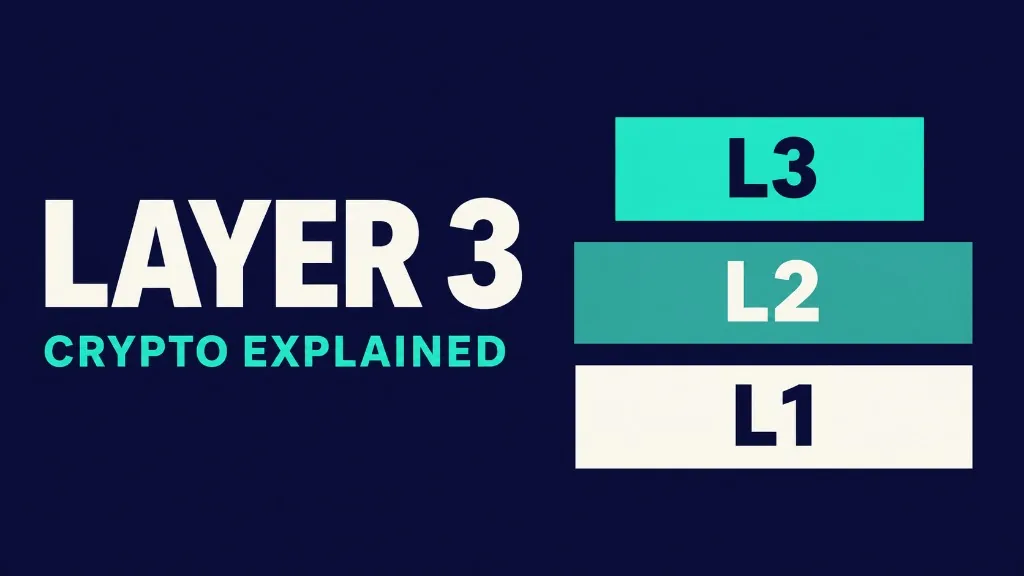
Layer 3 Crypto: What It Means Beyond Layer 1 and Layer 2
Learn what Layer 3 can mean in crypto, how it relates to Layer 1 and Layer 2, and why users should check network and bridge risks.
Learn what Layer 3 can mean in crypto, how it relates to Layer 1 and Layer 2, and why users should check network and bridge risks.
Quick Answer
Layer 3 crypto generally refers to an additional application-specific or scaling layer built above an existing blockchain stack. The term is not used in exactly the same way by every project. In some designs, Layer 3 focuses on specialized applications, custom execution environments, privacy, or lower-cost transactions built on top of Layer 2 infrastructure.
Key Takeaways
- Layer 1 is commonly the base blockchain; Layer 2 commonly adds scaling or execution capacity.
- Layer 3 is not a universal technical standard with one fixed definition.
- Projects may use Layer 3 for application-specific environments or additional scaling.
- More layers can improve specialization but may add bridge, wallet, and operational complexity.
- Users should verify network support before transferring assets between layers.
Key Table
| Layer | Typical role | User consideration |
|---|---|---|
| Layer 1 | Base settlement and security layer | Fees, confirmation time, network rules |
| Layer 2 | Scaling or execution layer built around Layer 1 | Bridge route, withdrawal process, wallet support |
| Layer 3 | Specialized app or additional execution environment | Compatibility, liquidity, bridge and contract risk |
Why Layer 3 Does Not Have One Fixed Meaning
Layer 1 and Layer 2 have become widely used labels, but Layer 3 is more flexible. Different projects may describe different architectures as Layer 3.
Some use the term for a specialized chain or environment designed for one type of application, such as gaming, trading, privacy, or high-frequency execution. Others use it to describe another layer that settles through existing Layer 2 systems. In modular blockchain designs, different layers may separate execution, settlement, data availability, and consensus functions.
The result is that the label alone does not tell you exactly how an application works. Users should look for the actual settlement path, bridge design, wallet requirements, and withdrawal process.
How Layer 3 Relates to Layer 1 and Layer 2
A simplified model is:
- Layer 1 provides the base blockchain and core security assumptions.
- Layer 2 processes activity in a way intended to reduce congestion or improve capacity while remaining connected to Layer 1.
- Layer 3 may add a more specialized environment on top of that stack.
In practice, the boundaries can be less neat. A project may use rollups, sidechains, separate application chains, or other systems that do not fit perfectly into one label. The goal is often to make certain applications cheaper, faster, or more customizable.
That does not mean the user experience is automatically simpler. Each added component may introduce another set of rules for deposits, withdrawals, bridges, token representations, and failure handling.
The Main User Risk: Network Assumptions
When moving assets across layers, users can face several distinct risks:
- selecting an unsupported network;
- using an unofficial bridge or copied website;
- holding a token representation that differs from the original asset;
- waiting through a withdrawal or settlement process;
- encountering limited liquidity in a specialized environment.
A lower fee is useful only when the route is compatible and understood. Before transferring assets, verify the exact asset, network, receiving address, and whether the destination supports the selected route. This deposit-network checklist is a useful starting point.
How to Evaluate a Layer 3 Project
Instead of relying on the label, ask:
- Where does the system ultimately settle?
- Which layer provides security for the transaction?
- How do users deposit and withdraw?
- Is a bridge required, and who controls it?
- Does the wallet support the exact network?
- What happens if the application or bridge is unavailable?
- Is liquidity sufficient for the intended use?
These questions are more useful than assuming “another layer” automatically means faster, cheaper, or safer.
Risk Disclaimer
Layered blockchain systems, bridges, and token transfers involve technical and operational risks. Verify the official route and transaction details before transferring assets. This article is for general education only and is not investment or technical advice.
Frequently asked questions
Is Layer 3 better than Layer 2?
Not automatically. Layer 3 may offer more specialization, but it can also add more technical and operational complexity.
Does Layer 3 mean lower transaction fees?
It may, depending on the architecture and demand. Fees can still change, and low cost does not guarantee network compatibility.
Can I send any token from Layer 1 directly to Layer 3?
Only if the relevant bridge, wallet, and destination application support that route. Always verify before sending.

Report the page and describe what should be reviewed.