
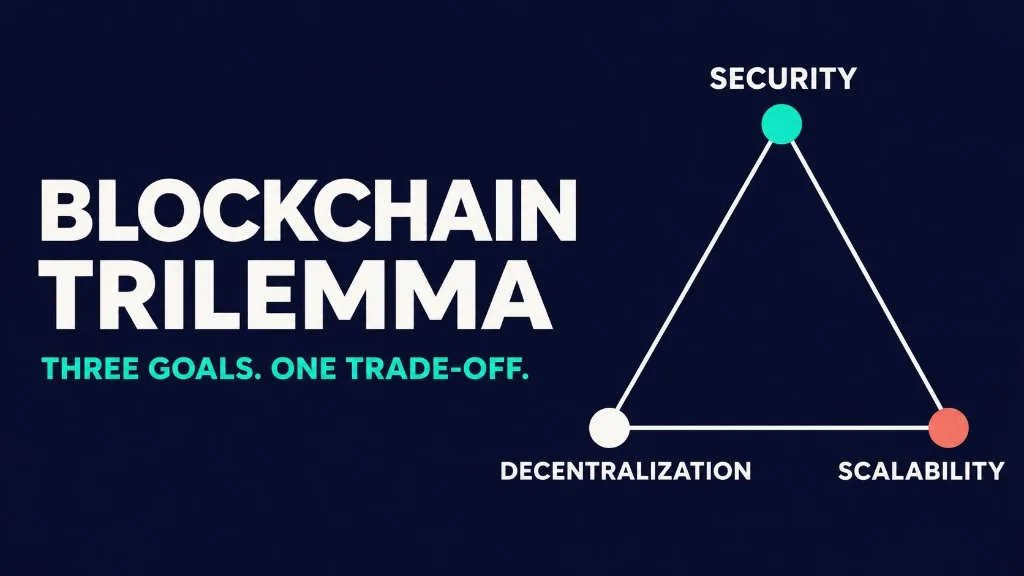
Blockchain Trilemma: Why Security, Scalability and Decentralization Trade Off
Learn what the blockchain trilemma means, why security, scalability and decentralization often require trade-offs, and how users should assess them.
Learn what the blockchain trilemma means, why security, scalability and decentralization often require trade-offs, and how users should assess them.
Quick Answer
The blockchain trilemma describes the difficulty of maximizing security, scalability, and decentralization at the same time. A network can improve one area, but the design choice may create costs or compromises in another. The trilemma is not a rule that every chain fails; it is a framework for asking what a network prioritizes and what users give up in return.
Key Takeaways
- Security concerns whether the network can resist attacks and preserve valid records.
- Scalability concerns transaction capacity, speed, and cost under growing demand.
- Decentralization concerns how broadly control, validation, and participation are distributed.
- Different networks make different trade-offs rather than solving all three perfectly.
- Users should consider these trade-offs when choosing an asset, wallet network, or application.
Key Table
| Dimension | Main question | Possible trade-off |
|---|---|---|
| Security | Can the network resist manipulation or attacks? | Stronger validation can require more time or resources |
| Scalability | Can the network handle high activity efficiently? | Higher throughput may require more specialized infrastructure |
| Decentralization | Can many independent participants validate or influence the network? | Broad participation can slow coordination and upgrades |
What the Blockchain Trilemma Means
A blockchain needs a way for participants to agree on which transactions are valid and in what order they occurred. It also needs to keep records difficult to alter, while remaining usable when activity rises.
The trilemma explains why these goals can pull in different directions. A network that processes more transactions may need larger hardware requirements, fewer validators, additional layers, or different coordination rules. A network that keeps participation very open may accept slower throughput or longer confirmation times. A network that emphasizes security may require conservative changes and more costly validation.
These are not automatically flaws. They are design choices. The important question is whether the choices match the job the network is meant to perform.
Security: More Than a Marketing Word
Security is not simply whether a blockchain has ever experienced an incident. It includes the cost of attacking the network, the quality of its validation rules, the reliability of its software, the distribution of control, and the process for responding to vulnerabilities.
For users, security also has an operational layer. A secure network does not protect a transfer sent to the wrong address, a compromised wallet, or a phishing victim. Before depositing or withdrawing, verify the selected asset, network, address, and any memo or tag requirement. This deposit-network checklist covers the practical checks that protocol-level security cannot perform for you.
Scalability: Speed Is Not the Only Metric
Scalability is often discussed as transactions per second, but user experience involves more than raw throughput. Fees, confirmation times, congestion behavior, application reliability, and bridge dependencies can all matter.
A network may scale through larger blocks, additional execution layers, specialized validator requirements, or off-chain and layer-two systems. Each method can improve capacity in a different way, but it may add operational complexity or create new trust assumptions.
For example, low fees are useful only if transfers remain reliable and users understand the route their assets take. When comparing networks for a deposit or withdrawal, do not select a network solely because it appears cheaper. Confirm that the receiving wallet or platform supports the same network.
Decentralization: Who Can Participate and Decide?
Decentralization asks how much control is distributed across validators, developers, infrastructure providers, token holders, and other participants. It is not a simple yes-or-no label.
A network may have many token holders but rely on a small group of infrastructure providers. Another may have broad validator participation but concentrated governance influence. A third may be highly distributed at the protocol layer but depend heavily on a few bridges or service providers for everyday use.
For traders and users, the practical takeaway is to look beyond slogans. Consider who validates transactions, how upgrades are approved, what happens during congestion, and whether important parts of the ecosystem depend on a small number of actors.
How to Use the Trilemma as a User
The blockchain trilemma is useful when it leads to better questions:
- Does this network prioritize low fees, settlement security, or broad participation?
- What assumptions am I making when I use a bridge or secondary layer?
- Is the network appropriate for a small payment, a large transfer, or long-term settlement?
- What happens if activity rises sharply?
- Do I understand the network selected for my transaction?
For a Bitget user, the most immediate application is simple: choose the correct supported network for each transfer, and do not assume that similar token names mean identical settlement paths.
Risk Disclaimer
Blockchain networks, bridges, wallets, and applications involve technical and market risks. Always verify transfer details before sending assets. This article is for general education only and is not investment, legal, or technical advice.
Frequently asked questions
Can one blockchain solve the trilemma completely?
No network has a universally perfect solution. Networks can improve trade-offs through new designs, but every design still has assumptions and limits.
Does a faster blockchain mean it is less secure?
Not necessarily. It means users should understand how speed is achieved and what infrastructure, validator, or trust assumptions are involved.
Why does the trilemma matter for withdrawals?
Different networks have different fees, confirmation behavior, compatibility rules, and security assumptions. Choosing the wrong network can create avoidable transfer risk.

Report the page and describe what should be reviewed.