
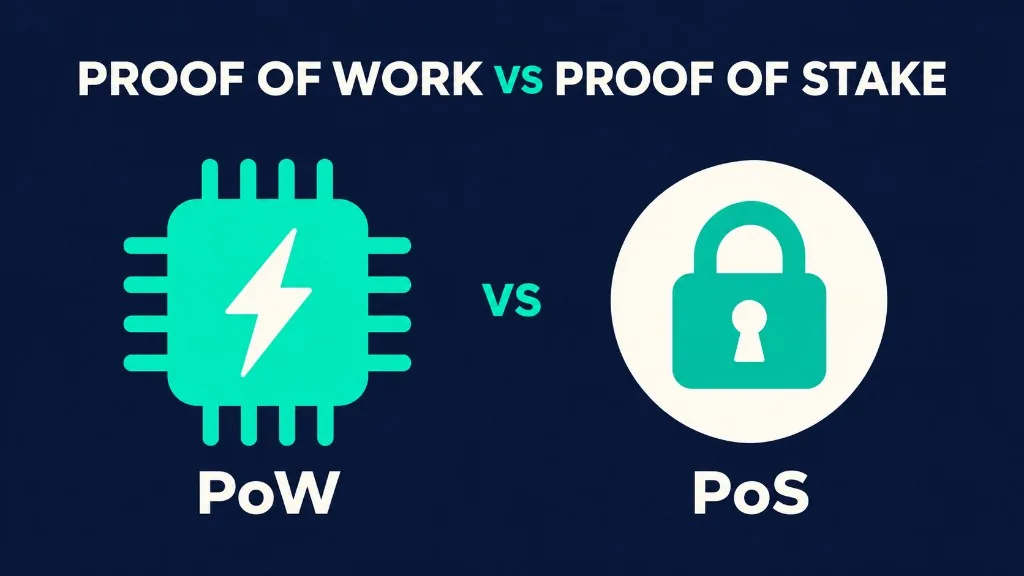
Proof of Work vs Proof of Stake: How Blockchain Validation Differs
Compare proof of work and proof of stake across validation, energy use, incentives, security assumptions and user considerations.
Compare proof of work and proof of stake across validation, energy use, incentives, security assumptions and user considerations.
Quick Answer
Proof of work and proof of stake are two ways blockchains agree on valid transactions. Proof of work relies on computing power to compete for block production, while proof of stake relies on participants locking assets as stake to take part in validation. Neither model removes risk; they use different incentives and security assumptions.
Key Takeaways
- Proof of work uses computational work to secure block production.
- Proof of stake uses staked assets and validator rules.
- The two systems differ in energy use, participation requirements, and attack incentives.
- Holding a token does not automatically mean you validate the network.
- Users should focus on the network’s rules, not assume one consensus model is universally superior.
Key Table
| Feature | Proof of Work | Proof of Stake |
|---|---|---|
| Main resource | Computing power and energy | Staked assets |
| Validator selection | Mining competition under network rules | Validator selection under staking rules |
| Main economic penalty | Cost of hardware and electricity | Potential loss or restriction of stake |
| User concern | Mining concentration and network security | Validator concentration and staking conditions |
| Common misconception | Mining means every holder controls the chain | Staking means every holder runs a validator |
How Proof of Work Operates
Proof of work requires participants, often called miners, to perform computational work in accordance with a network’s rules. The network makes block production costly, helping deter attempts to rewrite transaction history or submit invalid blocks.
The security model depends partly on the resources required to attack the network relative to the benefits of doing so. Hardware access, energy costs, mining-pool concentration, and software rules can all influence that picture.
For ordinary users, proof of work does not mean every transaction is automatically risk-free. Wallet security, address verification, and confirmation practices still matter. A valid blockchain transaction sent to an unintended address is not made reversible by the consensus model.
How Proof of Stake Operates
Proof of stake uses locked assets as an economic commitment. Validators participate according to the network’s selection and validation rules. If validators behave dishonestly or fail to meet required conditions, the network may impose penalties, depending on its design.
This approach can reduce the need for energy-intensive competition, but it introduces different questions. How much stake is needed to participate? Is validation concentrated among a small number of entities? Are staking services custodial or self-managed? What are the unbonding, delegation, and penalty rules?
The fact that a token can be staked does not mean staking is risk-free. Users should understand lock-up conditions, validator selection, smart-contract or service-provider exposure, and possible changes in token price.
Security Depends on More Than the Consensus Label
It is tempting to treat proof of work as “secure” and proof of stake as “efficient,” then stop there. In practice, security depends on implementation, validator or miner distribution, network maturity, client diversity, governance, operational resilience, and user behavior.
A network may use proof of stake but have broad validator participation. Another may use proof of work but have significant mining concentration. The consensus method is an important starting point, not the final conclusion.
When selecting a network for a transfer, users should prioritize supported network compatibility and transaction accuracy. This deposit-network checklist helps reduce operational mistakes that consensus mechanisms cannot correct.
What Traders and Users Should Watch
The choice between proof of work and proof of stake may matter to a user in several ways:
- network fees and confirmation behavior;
- validator or miner concentration;
- staking, lock-up, or delegation conditions;
- the network’s upgrade process;
- the risks of third-party staking services;
- the compatibility of wallets and transfer networks.
Do not choose an asset solely because it uses one consensus model. A trading decision should also account for liquidity, custody, market volatility, utility, and your own risk tolerance.
Risk Disclaimer
Staking, mining, and crypto asset transfers involve technical, market, and operational risks. This article is general education only and is not investment, tax, or legal advice.
Frequently asked questions
Is proof of stake safer than proof of work?
Neither is automatically safer in every situation. Each uses a different model, and real-world security depends on implementation and participation.
Does proof of stake guarantee yield?
No. Staking rewards, if available, may involve lock-up conditions, validator risk, price volatility, and other factors.
Why does consensus matter when I withdraw crypto?
Consensus affects how a network validates and confirms transactions, while network compatibility determines whether the receiving address can accept the transfer. Both matter.

Report the page and describe what should be reviewed.