
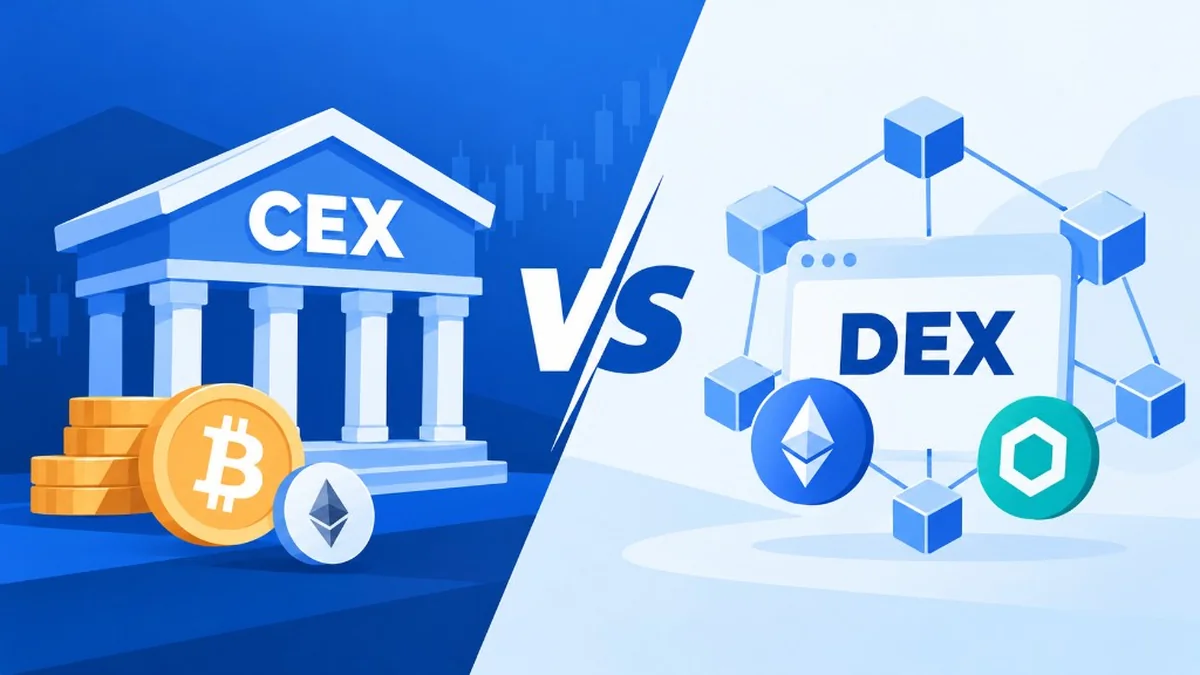
CEX vs DEX: Custody, Liquidity, Fees and Trading Risk
Compare CEX vs DEX across custody, liquidity, fees, account security, self-custody and trading workflows for crypto users.
Compare CEX vs DEX across custody, liquidity, fees, account security, self-custody and trading workflows for crypto users.
Quick Answer
CEX vs DEX is mainly a custody and workflow decision. A centralized exchange, or CEX, uses accounts, platform custody, order books and platform-managed trading flows. A decentralized exchange, or DEX, usually lets users trade from a non custodial wallet through smart contracts.
For Bitget users, the practical choice depends on the task: fiat access, high-liquidity trading and support workflows usually favor a CEX; self-custody and direct onchain access usually favor a DEX.
Key Takeaways
- A CEX is usually easier for onboarding, spot trading, futures, P2P and support.
- A DEX gives more wallet control but requires stronger self-custody habits.
- CEX risk centers on platform custody, account security and withdrawal rules.
- DEX risk centers on smart contracts, wallet approvals, slippage and fake tokens.
- Many traders use both: a CEX for liquidity and a wallet/DEX for onchain activity.
- Account-side security remains important; see BGBriefing’s Bitget security guide.
Key Table
| Factor | CEX | DEX |
|---|---|---|
| Custody | Platform custody/account balance | User wallet/self-custody |
| Access | Login, KYC, account controls | Wallet connection |
| Liquidity | Often deeper for major pairs | Varies by pool and chain |
| Fees | Trading fees, spreads, withdrawal/network fees | Gas, pool fees, slippage |
| Support | Platform support may exist | Usually limited or none |
| Main risk | Platform/account risk | Contract/wallet approval risk |
CEX Meaning in Crypto
CEX means centralized exchange. It is a platform where users create accounts, deposit assets, trade through the platform interface and withdraw funds when needed.
A custodial exchange can be useful when traders want speed, liquidity, product access and account-level controls. On Bitget-like workflows, that can include spot markets, derivatives, P2P, card routes and other platform features.
For fiat and peer-to-peer style deposit workflows, see BGBriefing’s Bitget P2P guide.
What a DEX Changes
A DEX does not usually require a traditional account balance. Instead, the user connects a non custodial wallet and trades through smart contracts or liquidity pools.
This gives more control, but it also moves more responsibility to the user. The wallet must be protected, token contracts must be checked and approvals must be managed carefully.
Wallet-based products can also look different from exchange products. BGBriefing’s Bitget Wallet Card guide is a useful example of how wallet workflows differ from exchange trading.
Fees: CEX vs DEX
CEX costs often include maker/taker fees, spread, funding for perpetual futures and network fees for withdrawals. DEX costs often include gas, liquidity-pool fees, price impact and slippage.
Neither model is always cheaper. A small DEX trade on a cheap network may cost little. A large DEX trade in a thin pool may suffer heavy price impact. A CEX trade may have clear fees, but withdrawal and funding costs still matter.
Liquidity and Execution
CEX liquidity is often deeper for major pairs because many orders sit in a central order book. That can help with tighter spreads and faster execution.
DEX liquidity depends on the chain, pool depth and token pair. It can be strong for popular assets but fragile for new or thinly traded tokens.
Which Should You Use?
Use a CEX when you need fiat routes, large-pair liquidity, futures, account support or a simpler trading interface.
Use a DEX when you need onchain access, wallet-based execution or assets not available on centralized venues.
The safer answer for many traders is not “CEX only” or “DEX only.” It is to separate workflows: trading capital, self-custody capital and experimental onchain capital should not all sit in the same risk bucket.
Practical Decision Framework
Use a CEX when the job is account-based trading: fiat or P2P access, deep major-pair liquidity, futures access, support workflows and product packages.
Use a DEX when the job is wallet-based execution: self-custody, onchain token access, or assets that are not listed on the centralized venue you use.
Many Bitget users do not need an either-or answer. They need a capital split. Keep active trading capital on the CEX, keep longer-term holdings under clearer self-custody rules, and keep experimental onchain activity small and isolated.
Security Habits Differ by Venue
On a CEX, the priority is account hygiene: strong authentication, phishing resistance, withdrawal controls and device security.
On a DEX, the priority is wallet hygiene: recovery phrase protection, contract verification, approval management and fake-token checks.
Switching venues without switching habits is a common failure mode. A user who is careful on an exchange can still lose funds quickly onchain after approving a malicious contract.
Fee Comparison in Practice
Compare total cost, not one fee line.
A CEX trade may look cheaper until withdrawal fees, funding and spreads are included. A DEX trade may look cheap until gas and price impact appear on a thin pool. Decide based on the full route: entry, hold, exit and any transfer required after the trade.
Risk Disclaimer
Crypto trading involves market, custody, execution, smart contract and platform risk. This article is educational and is not financial advice.
Frequently asked questions
What is CEX vs DEX?
CEX vs DEX compares centralized exchanges with decentralized exchanges. The biggest difference is custody: CEX platforms manage account balances, while DEX trades usually happen from user-controlled wallets.
Is a DEX safer than a CEX?
Not automatically. A DEX reduces platform custody risk but increases smart contract, wallet, approval and phishing risk.
Is Bitget a CEX?
Bitget’s exchange workflows are centralized exchange workflows. Users should still check product eligibility, account security and regional rules.
Can traders use both CEX and DEX?
Yes. Many users trade liquid markets on a CEX and use wallets or DEXs for onchain activity.
What is a custodial exchange in this comparison?
A custodial exchange is a centralized venue where the platform manages account balances and users access funds through login, security checks and withdrawal rules.

Report the page and describe what should be reviewed.