
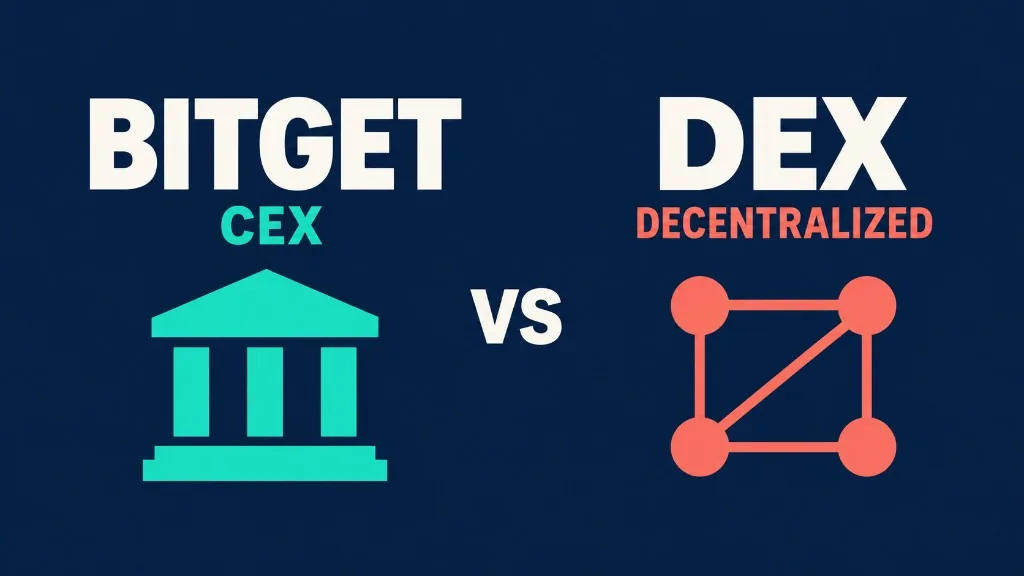
Bitget vs DEX: How to Choose Between a CEX and a DEX
Compare Bitget and decentralized exchanges by custody, liquidity, execution, fees, wallet risk, and trading workflow.
Compare Bitget and decentralized exchanges by custody, liquidity, execution, fees, wallet risk, and trading workflow.
Quick Answer
The practical difference in the CEX vs DEX decision is not simply “centralized versus decentralized.” It is a trade-off between convenience, custody, liquidity, execution control, and operational responsibility.
Bitget, as a centralized exchange, can be more straightforward for traders who want an account-based workflow, order-book trading, centralized risk controls, and easier movement between spot and derivatives products. A DEX can be more suitable when self-custody, wallet-based access, or direct interaction with on-chain assets matters more than centralized account features.
The best choice depends on what can go wrong in your specific trade. On a CEX, platform and account-security risk matter. On a DEX, wallet security, token-contract risk, network fees, liquidity fragmentation, and transaction-finality risk matter more.
Key Takeaways
- A CEX such as Bitget usually offers a simpler trading workflow and centralized account management.
- A DEX lets you trade from a self-custodied wallet, but you are responsible for approvals, private keys, and network selection.
- CEX liquidity can be easier to assess through order books; DEX liquidity may differ by pool, chain, and token pair.
- “Not your keys, not your coins” is relevant, but self-custody also means there may be no recovery path after a wallet or signing mistake.
- Many active traders use both: a CEX for execution and account tools, and a DEX for selected on-chain opportunities.
Key Table
| Decision area | Bitget / CEX workflow | DEX workflow | What to check before trading |
|---|---|---|---|
| Account access | Email, app, login, and platform account | Wallet connection and signature | Account or wallet security setup |
| Custody | Platform manages operational custody | You control wallet keys | Who can move the assets? |
| Trading interface | Centralized order book and account dashboard | AMM, order-book DEX, or aggregator | Slippage, liquidity, and execution method |
| Asset availability | Listed assets under platform rules | On-chain tokens can appear earlier | Contract address and token legitimacy |
| Errors | Support and account controls may be available | Signed transactions are often final | Network, recipient, approval, and amount |
| Costs | Trading fees and possible funding costs | Gas, swap fees, routing, and slippage | Total cost, not only headline fee |
| Main risk | Platform, account, and counterparty risk | Wallet, smart-contract, token, and on-chain risk |
A CEX and a DEX solve different trading problems
A centralized exchange is built around an account. You deposit assets or acquire them through supported methods, then use the platform’s trading interface to place orders. The exchange coordinates matching, displays balances, applies its risk controls, and provides a single place to review orders, transfers, and account settings.
A decentralized exchange is built around a wallet. Instead of logging in with a conventional account, you connect a wallet and authorize transactions through signatures. The trade may be executed through an automated market maker, an on-chain order book, or an aggregator that searches across multiple liquidity sources.
That difference changes the user experience immediately. On Bitget, a trader may think first about account permissions, order type, margin mode, and withdrawal controls. On a DEX, the first questions are often: Is this the correct chain? Is the token contract genuine? What am I approving? How much slippage is acceptable? Will the transaction settle before the price changes?
Neither workflow removes risk. They move risk into different places.
When a Bitget-style CEX workflow may fit better
A CEX workflow can make more sense when you value speed, a familiar interface, and a consolidated view of your positions. Traders who use limit orders, monitor several positions, or move between spot and derivatives may prefer having balances, trading controls, and account protection in one environment.
Liquidity is another practical consideration. In liquid markets, centralized order books can make the visible bid-ask spread and available depth easier to inspect before placing an order. That does not guarantee a better execution price in every case, but it gives the trader a clear view of the order book and available order types.
For newer users, the support structure also matters. A platform account can offer security features such as login controls, withdrawal-address management, and identity checks. Those tools do not eliminate the need for caution: phishing, stolen credentials, and compromised devices remain serious risks. The basic protections in this account security checklist should be in place before holding meaningful assets on any exchange.
A CEX is also generally more convenient when you want to avoid manually bridging assets, switching networks, or paying gas on multiple chains. Convenience, however, should not be mistaken for zero custody risk. You should still understand withdrawal rules, confirmation requirements, and the distinction between trading balance and assets held in a personal wallet.
When a DEX may fit better
A DEX may be more attractive if self-custody is central to your strategy. You can connect a wallet, keep control of the signing keys, and interact directly with on-chain liquidity without first transferring funds into a centralized trading account.
This is useful for traders who want access to specific chains, newly launched on-chain assets, or DeFi applications that do not operate through a conventional exchange account. It can also reduce reliance on a single platform’s listing policy or account-access process.
The trade-off is that the user becomes the final control point. A wrong wallet approval, malicious token contract, incorrect recipient address, or transaction signed on the wrong network can be difficult or impossible to reverse. A DEX interface can look legitimate while routing a transaction to an unsafe contract. Treat contract addresses as critical data, not as a detail to skim past.
Before connecting a wallet, check the site URL, verify the chain, review the permissions requested, and avoid signing messages or approvals you do not understand. If a token is new or thinly traded, test with a small amount first and inspect the likely slippage before confirming the transaction.
Fees: compare total trading cost, not just one number
Comparing a CEX and DEX by the visible trading fee alone can be misleading.
On a centralized exchange, total cost may include the trading fee, spread, funding where applicable, borrowing costs for margin products, and withdrawal charges. On a DEX, a trade can include liquidity-provider fees, network gas, routing fees, bridge fees, and price impact from limited liquidity.
A low swap fee does not help much if the transaction has high gas costs or the pool is shallow. Likewise, a low advertised exchange fee may not be the whole picture if you are trading an illiquid pair with a wide spread.
For a fair comparison, estimate the complete cost of a trade at the time you intend to make it:
- Price shown before execution.
- Expected fill price or swap output.
- Platform or pool fee.
- Network and bridge fees.
- Slippage or price impact.
- Cost of moving assets back to your preferred storage or trading venue.
For a broader explanation of how trading charges can interact, see how platform fees work.
A sensible way to use both
For many traders, the CEX vs DEX question does not require an all-or-nothing answer. A CEX can be the primary venue for highly liquid trading, portfolio monitoring, and structured order execution. A DEX can be used selectively for on-chain opportunities or assets unavailable through the centralized route.
If you use both, separate your operating habits. Keep only the assets you need for active activity in a connected wallet. Use a dedicated wallet for experimenting with new protocols. Do not reuse the same wallet for every application, and do not treat an exchange account and a browser wallet as if they have the same failure modes.
The better choice is the one whose risks you can identify, monitor, and control before you trade.
Risk Disclaimer
Crypto assets and derivatives involve significant risk. This article is for general information only and is not investment, legal, tax, or trading advice. Verify current product availability, fees, network status, and local eligibility before acting.
Frequently asked questions
Is a DEX safer than a CEX?
Not automatically. A DEX reduces reliance on centralized custody, but it introduces wallet, smart-contract, token, and signing risks. A CEX can offer centralized security controls, while still carrying platform and account-access risk.
Can I use Bitget and a DEX at the same time?
Yes. Many traders use a centralized exchange for liquid markets and a DEX for selected on-chain activity. Keep transfers, network choices, and wallet permissions organized.
Are DEX fees always lower?
No. Gas, slippage, routing, and bridge costs can make a DEX trade more expensive than expected, particularly on congested networks or low-liquidity pools.
What is the biggest beginner mistake on a DEX?
Treating wallet signatures and token approvals as routine clicks. Read what you are approving, verify the site and chain, and test new workflows with small amounts.

Report the page and describe what should be reviewed.